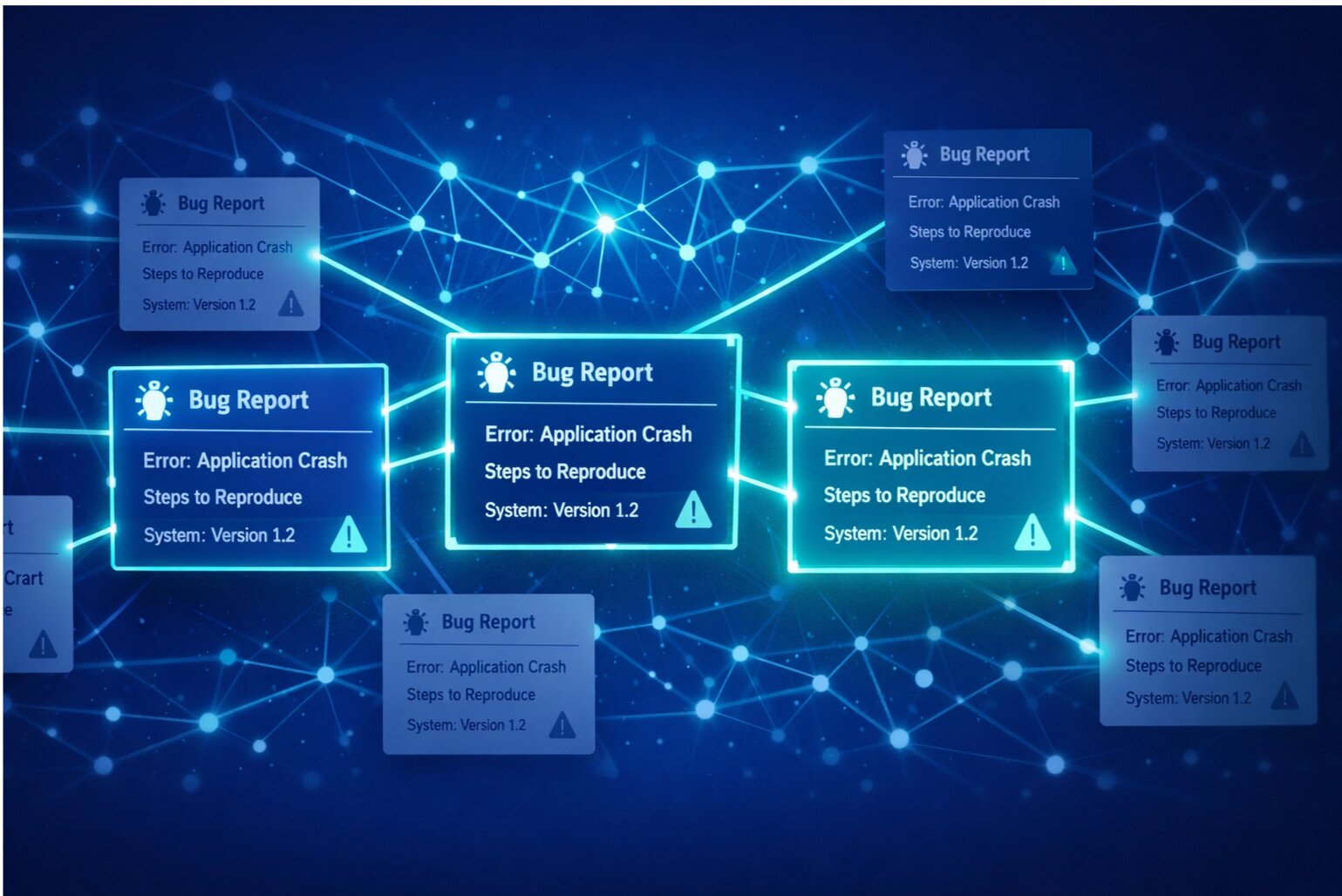
"We already fixed that." The most frustrating phrase in QA. Two bugs reported separately. Sound different. Investigated separately. Fixed twice. Wasted effort. AI duplicate detection stops this.
The Duplicate Problem
In large teams with many bugs per day, duplicates slip through:
- Bug: "Login page hangs" (Reports 10)
- Bug: "Sign-in button doesn't work" (Reports 20)
- These are likely the same issue, reported differently
Two developers investigate independently. Each fixes it separately. One fix is lost or causes issues. Time and resources wasted.
Simple String Matching Doesn't Work
Approach 1: Exact String Match "Form validation fails" and "Form validation error" don't match, even though they're the same issue.
Approach 2: Keyword Search Search for "validation" finds both. But also finds "Form password validation broken" which is a different bug.
Solution: Semantic Understanding AI understands meaning, not just words.
How AI Duplicate Detection Works
1. Semantic Analysis
AI converts bug reports into semantic meaning:
"Login page hangs" → "Authentication system doesn't respond in time"
"Sign-in button doesn't work" → "Authentication system doesn't respond in time"
Despite different words, AI recognizes they mean the same thing.
2. Context Embedding
AI considers context:
- What browser/environment the bug occurs in
- What steps led to it
- What systems are involved
- Historical similar bugs
"Button doesn't work" on the login page means something different than "Button doesn't work" on the checkout page.
3. Similarity Scoring
Instead of binary "same" or "different," AI scores similarity 0-100%:
- 90-100%: Highly likely the same bug (flag for human review)
- 70-89%: Probably the same bug (suggest merge)
- 50-69%: Possibly related (show as related, don't auto-merge)
- <50%: Different issues (treat separately)
4. Multi-Factor Analysis
AI considers multiple signals:
- Title/Description Similarity: Do the words overlap?
- Technical Data: Same browser? Same API endpoint? Same error code?
- Session Data: Do session replays show similar activity before the bug?
- Stack Traces: Do error messages point to the same code?
- Temporal Proximity: Reported within 5 minutes? More likely same bug.
A single strong signal might suggest duplication. Multiple weak signals combined create confidence.
Real-World Duplicate Patterns
Pattern 1: Same Bug, Different Descriptions
Report A: "Dashboard doesn't load" Report B: "Dashboard takes forever" Report C: "Dashboard loading spinner stuck"
All three describe the same issue: dashboard hangs. AI recognizes the semantic overlap.
Pattern 2: Root Cause vs Symptom
Report A: "User can't submit the form" Report B: "API returns 500 error"
Report A is the symptom. Report B is the root cause. A good duplicate detector links them so developers understand the connection.
Pattern 3: Browser-Specific Duplicates
Report A: "Form doesn't validate on Chrome" Report B: "Form doesn't validate on Safari"
Same root cause (form validation broken), different browsers. Report as variants of the same bug, not separate bugs.
Pattern 4: Multi-Step vs Single-Step
Report A: "When I edit my profile, clear the name field, and submit, it shows an error" Report B: "Submitting an empty name field fails"
Report A describes one specific scenario. Report B describes the general rule. They're related. One is a specific reproduction case of the general issue.
The Benefits Beyond Avoiding Rework
Cleaner Backlog
Without deduplication, backlog fills with duplicate bugs. Team spends time triaging duplicates instead of addressing unique issues.
Better Prioritization
"Form validation failing" reported 15 times means it's affecting many users. Consolidating duplicates reveals this high-impact issue immediately.
Accurate Impact Assessment
"Database connection timeout" reported 50 times. This is a major issue affecting many users. Without deduplication, you might think it's 50 separate minor issues.
Faster Root Cause Analysis
Multiple reports of the same bug provide multiple reproduction paths. One report shows the bug on Chrome. Another on Safari. Another on mobile. Together, they reveal the bug affects all platforms, making root cause obvious.
Teaching AI About Duplicates
Supervised Learning
AI learns better when you provide examples:
- Mark duplicates when you see them
- AI learns from your decisions
- Over time, accuracy improves
Domain-Specific Knowledge
Different products have different duplicate patterns. An e-commerce site and a SaaS product have different duplicate signatures. Customizing AI to your domain improves accuracy.
Threshold Tuning
What similarity score triggers a warning? Adjust based on false positives:
- Too low: Too many false positives (reports marked similar when they're different)
- Too high: Miss real duplicates
Tune to your tolerance for false positives vs false negatives.
Handling Edge Cases
Intentional Duplicates
Sometimes the same bug affects multiple areas of your app. These aren't true duplicates—they're related issues in different code paths. Mark them as related, not merged.
Cascading Issues
One bug causes 5 other bugs. Is "Form validation fails" a duplicate of "Submit button doesn't work"? Technically different bugs, but fix one and the other might resolve. Link them but keep separate.
The Human-in-the-Loop
AI suggests duplicates. Humans confirm. This balance catches duplicates while avoiding auto-merging bugs that are actually different. Always allow manual override.
Measuring Deduplication Impact
- Before AI: 150 bugs reported per week, 20% are duplicates (30 wasted)
- With AI: 150 bugs reported, 95% of duplicates caught (28 prevented, only 2 missed)
- Impact: QA team spends 5+ hours less per week investigating duplicates
The Future: Proactive Deduplication
Eventually, AI won't just detect duplicates after they're reported. It'll prevent them:
"Before you submit this bug report, did you know there's already a report 92% similar? Here it is. Want to add to that instead?"
This becomes standard practice.
Stop wasting time on duplicate bugs. SnagRelay's AI automatically detects and consolidates duplicate reports, saving your team hours every week.